

2025/12/23(二) 2025 International Health, AI & Sustainable Development Forum
Time:2025/12/23(二) 8:40-20:00
Place:College of Social Sciences, National Cheng Kung University, 3F Auditorium
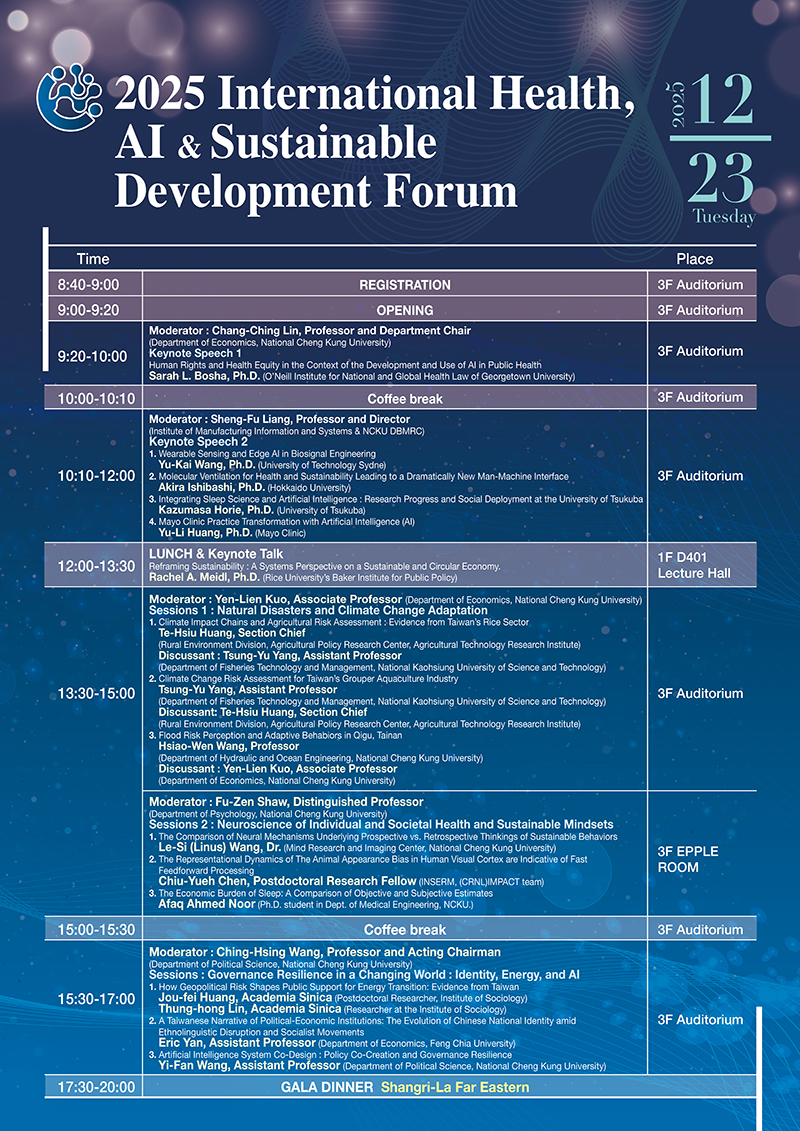
9:20-10:00 Keynote Speech 1
Moderator:Chang-Ching Lin, Professor and Department chair (Department of Economics, National Cheng Kung University)
🌏 https://www.econ.ncku.edu.tw/faculty_detail.asp?ID=103
Human Rights and Health Equity in the Context of the Development and Use of AI in Public Health
Sarah L. Bosha, Ph.D. (O’Neill Institute for National and Global Health Law or Georgetown University)
🌏 https://oneill.law.georgetown.edu/experts/sarah-bosha/
10:10-12:00 Keynote Speech 2
Moderator:Sheng-Fu Liang, Professor and Director (Institute of Manufacturing Information and Systems & NCKU DBMRC)
1. Wearable Sensing and Edge Al in Biosignal Engineering
Yu-Kai Wang, Ph.D. (University of Technology Sydne)
📋 CV
Eng: Wearable sensors and AI are emerging fields that aim to enhance human capabilities and well-being. AI-based data analysing, human state monitoring, and model optimizing are the emerging topics. Multiple applications such as precise digital healthcare, better human-agent interaction, and immersive media can benefit from the development of advanced AI and wearable sensors on edge devices. In this talk, I will provide an overview of my work which touches these technologies, challenges, and research opportunities.
2. Molecular Ventilation for Health and Sustainability Leading to a Dramatically New Man-Machine Interface
Akira Ishibashi, Ph.D. (Hokkaido University)
📋 CV
We have developed closed airflow systems based on clean unit system platform (CUSP) combined with gas exchange membrane (GEM). In conventional clean rooms, mechanical ventilation is used as a defact standard, but in the CUSP/GEM system, fresh air is introduced, through diffusion of gas molecules, where O2, CO2, and other molecules come and go crossing the GEM depending on the concentration gradient across the GEM. Since ventilation is accomplished not by airflow but by molecules diffusion, particles and microbes being much larger in size than molecules cannot go across the GEM and the CUSP/GEM system can serve as an ideal space for health and safety applications in SDGs-friendly manner with sustainability and low power consumption. Also, the closed airflow system of CUSP/GEM system, being able to detect molecular concentration quite sensitively, could be used as a possible new man-machine interface that operates perceiving what you know and even what you don’t about yourself. The CUSP/GEM system would help us, the individuals consisting of body and brain, take a “vector sum” of current two mega-trends of SDGs and IT/AI to solve crucial problems we have been confronting.
3. Integrating Sleep Science and Artificial Intelligence: Research Progress and Social Deployment at the University of Tsukuba
Kazumasa Horie, Ph.D. (University of Tsukuba)
🌏 https://kdesleep-code.github.io/
Sleep deprivation has become a serious social and economic issue in Japan.
While sleep was once sacrificed to support economic growth, chronic sleep loss is now associated with reduced productivity and economic loss at the national level. Despite growing awareness of the importance of sleep, large-scale improvement has been limited, partly because individuals cannot easily assess their own sleep condition in an objective and clinically meaningful way.
In this talk, I present an AI-based automatic sleep stage scoring system developed through an interdisciplinary approach integrating information science, sleep medicine, and social implementation. The core of this work is the development of a home sleep EEG device and an automatic sleep stage scoring model, designed with three key requirements in mind: high accuracy, explainability, and low computational cost, all of which are essential for clinical and commercial use.
In addition, I discuss how social implementation influenced the research itself, enabling large-scale data collection and opening new research opportunities in populations that are difficult to study in hospital settings. This work illustrates how AI-based sleep technologies can bridge daily life and clinical practice, similar to the role home blood pressure monitoring has played in hypertension management.
4. Mayo Clinic Practice Transformation with Artificial Intelligence (AI)
Yu-Li Huang, Ph.D. (Mayo Clinic)
📋 CV
This presentation provides: 1. Facts regarding Mayo Clinic and Kern Center for the Science of Health Care Delivery; 2. Mission for artificial intelligence (AI) works in process improvement space for practice transformation; 3. Projects demonstration on the impact of operational efficiency using operations research, data science, and system engineering principles; 4. The skills needed to succeed in healthcare environment, closing the gap between theory and practice.
12:00-13:30 LUNCH & Keynote Talk
Reframing Sustainability: A Systems Perspective on a Sustainable and Circular Economy
Rachel A. Meidl, Ph.D. (Rice University’s Baker Institute for Public Policy)
🌏 https://www.bakerinstitute.org/expert/rachel-meidl
📋 CV
The notion of sustainability is often presented as a win-win situation. However, success requires a holistic, cross-disciplinary, and multidimensional approach that accounts for the costs and benefits across life cycles to ensure presumed solutions do not shift risks across supply chains and offset social, economic, or environmental gains. Global energy production, resource demands, heightened environmental and social concerns, and the growing waste crisis have spurred an increased focus on sustainable strategies and a circular economy. Failure to systematically approach energy and material transitions has led to distorted investments and policy priorities that are misaligned with the growing demand for plastics, metals, and other materials and incongruous with the principles of a sustainable and circular economy.
13:30-15:00 Sessions 1: Natural Disasters and Climate Change Adaptation
Moderator:Yen-Lien Kuo, Associate Professor (Department of Economics, National Cheng Kung University)
🌏 https://www.econ.ncku.edu.tw/faculty_detail.asp?ID=92
1. Climate Impact Chains and Agricultural Risk Assessment: Evidence from Taiwan’s Rice Sector
Te-Hsiu Huang, Section Chief (Rural Environment Division, Agricultural Policy Research Center, Agricultural Technology Research Institute)
🌏 https://www.atri.org.tw/introduction_03/page/11
This study investigates coastal villages in Qigu, Tainan, using a questionnaire to explore residents’ flood-risk perception, reliance on engineering measures, and their relationship with climate-change perception and adaptation behaviors. Results show that residents generally exhibit high awareness of flood risks, especially concerning typhoon-induced flooding. While most respondents acknowledge the effectiveness of engineering measures, many also support non-engineering strategies, indicating a shift toward more diversified disaster-prevention perspectives. Most residents perceive increasing flood risk in recent years and show strong sensitivity to extreme rainfall and environmental changes. Analysis reveals that a sense of personal control is strongly associated with climate change perception, and residents with higher risk awareness tend to place greater trust in engineering solutions, suggesting possible overreliance. Regression results indicate that flood risk and climate change perception increase the likelihood of adopting high cost adaptation actions; however,recognition of non-engineering measures more effectively promotes autonomous adaptation behaviors. Overall, diversified strategies beyond engineering approaches appear essential for strengthening community resilience.
氣候變遷對農業生產的威脅情勢日益加劇,凸顯風險評估及調適規劃的重要。本研究透過利害關係人參與式風險評估,分析高溫對中臺灣近未來的稻米生產風險。研究結合針對農藝與水稻育種專家、產業政策專家與糧商之深度訪談,以及由農會、農民、糧商及相關產業人員參與的工作坊,與稻米產業利害關係人共同建構「高溫對水稻生產風險」的衝擊鏈。研究結果顯示高溫對於作物生產的直接衝擊──土壤生產力下降、水稻植株生理障礙及高溫環境威脅,稻米白堊質粒增加的問題外,並也指認出精緻化氣候資訊不足、栽培管理習慣、品種選擇慣性等等的脆弱度因素。儘管農業部門累積多元調適技術選項,實務上仍面臨水資源調度限制、公糧收購機制以產量為導向、現有資訊難以觸及中高齡農民等等調適障礙,以及其他病蟲害問題、農民收益降低等轉型風險。相較於既有研究多聚焦氣候異常變化趨勢及其對作物品項的負面影響,本研究擴充氣候變遷背景下,技術、制度、社會和經濟面向之農業調適路徑知識空白,強調調適路徑非單純的品種或技術選擇問題,而深受風險脆弱度、農民風險決策偏好、制度慣性,以及資訊和資源流動等複雜因素的影響。未來調適規劃須納入這些關鍵驅動因子,並強化氣候與作物科學於田間實務間的有效轉譯,避免調適不良。
2. Climate Change Risk Assessment for Taiwan’s Grouper Aquaculture Industry
Tsung-Yu Yang, Assistant Professor (Department of Fisheries Technology and Management, National Kaohsiung University of Science and Technology)
🌏 https://dftm.nkust.edu.tw/p/426-1139-64.php
本研究利用地理資訊系統(GIS)整合氣候資料、空間資料庫和養殖數據,評估台灣石斑魚養殖業在氣候變遷情境下的脆弱性及漁損金額的空間分布與異質性。結果顯示,全球暖化趨勢導致高溫與強降雨下的潛在漁損金額與面積增加,且因養殖魚種與型態的差異呈現空間與時間上的異質性。針對這些結果,研究提出短期強化技術管理、中期利用大數據調整適養地區、長期選育耐氣候新品種等調適策略,為政府政策制定及養殖業者提升氣候變遷應對能力提供參考。
3. Flood Risk Perception and Adaptive Behabiors in Qigu, Tainan
Hsiao-Wen Wang, Professor (Department of Hydraulic and Ocean Engineering, National Cheng Kung University)
🌏 https://researchoutput.ncku.edu.tw/en/persons/hsiao-wen-wang-2/
This study investigates coastal villages in Qigu, Tainan, using a questionnaire to explore residents’ flood-risk perception, reliance on engineering measures, and their relationship with climate-change perception and adaptation behaviors. Results show that residents generally exhibit high awareness of flood risks, especially concerning typhoon-induced flooding. While most respondents acknowledge the effectiveness of engineering measures, many also support non-engineering strategies, indicating a shift toward more diversified disaster-prevention perspectives. Most residents perceive increasing flood risk in recent years and show strong sensitivity to extreme rainfall and environmental changes. Analysis reveals that a sense of personal control is strongly associated with climate change perception, and residents with higher risk awareness tend to place greater trust in engineering solutions, suggesting possible overreliance. Regression results indicate that flood risk and climate change perception increase the likelihood of adopting high cost adaptation actions; however,recognition of non-engineering measures more effectively promotes autonomous adaptation behaviors. Overall, diversified strategies beyond engineering approaches appear essential for strengthening community resilience.
本研究以台南市七股區為研究範圍,透過問卷調查探討居民的洪水風險知覺、對工程措施的依賴程度,以及其與氣候變遷知覺與調適行為的關聯。結果顯示,七股居民普遍具有高度洪水風險意識,尤其對颱風引發的淹水格外關切。雖普遍肯定工程措施的防洪效果,但亦有相當比例支持非工程策略,反映防災觀念逐漸多元。多數居民認為近年淹水風險上升,對極端降雨與居住環境變遷具高度敏感度。分析顯示,個人可控性感受與氣候變遷知覺高度相關,風險感越強者越傾向信任工程手段,可能出現過度依賴。迴歸結果指出,洪水風險與氣候變遷知覺可提升居民採取高成本調適行為的可能性,而對非工程措施的認同更能有效促進自主調適,顯示多元策略比單靠工程更能強化社區韌性。
13:30-15:00 Sessions 2: Neuroscience of Individual and Societal Health and Sustainable Mindsets
Moderator:Fu-Zen Shaw, Distinguished Professor (Department of Psychology, National Cheng Kung University)
🌏 https://psychology.ncku.edu.tw/Teacher_Detail.aspx?ID=c0355d79-3c14-4377-a190-e8d274fd8a85
1. The Comparison of Neural Mechanisms Underlying Prospective vs. Retrospective Thinkings of Sustainable Behaviors
Le-Si (Linus) Wang, Dr. (Mind Research and Imaging Center, National Cheng Kung University)
Understanding the psychological and neural mechanisms underlying sustainable behavior is essential in the face of environmental crises. This preregistered fMRI study aimed to replicate and extend Brevers et al. (2021) by investigating how imagining oneself engaging in sustainable or unsustainable actions—either in the past or in the future—influences behavioral responses and brain activity. We recruited 50 university students in Taiwan, who viewed images depicting everyday behaviors with varying environmental impacts and simulated themselves performing those actions
either in the past or the future. After each simulation, participants rated the perceived feasibility of the behavior. Behaviorally, participants reported more frequent engagement in unsustainable behaviors in the past but showed a stronger intention to engage in sustainable behaviors in the future. Neuroimaging results revealed greater activation in the right dorsolateral prefrontal cortex (dlPFC) when simulating future sustainable actions. Psychophysiological interaction (PPI) analyses showed reduced functional connectivity between this region and both the left hippocampus and the middle temporal gyrus during these simulations. A multivariate pattern analysis identified the right insula as a key region distinguishing sustainable from unsustainable behavior simulations. These findings offer new insights into the neural and cognitive processes supporting sustainable decision-making and highlight potential neural markers of environmental engagement.
2. The Representational Dynamics of The Animal Appearance Bias in Human Visual Cortex are Indicative of Fast Feedforward Processing
Chiu-Yueh Chen, Postdoctoral Research Fellow (INSERM, (CRNL)IMPACT team)
📋 CV
The human visual system has a seemingly unique tendency to interpret zoomorphic objects as animals, not as objects. This animal appearance bias is very strong in the ventral visual pathway, as measured with functional magnetic resonance imaging (fMRI), but it is absent in feedforward deep convolutional neural networks. Here we investigate how this bias emerges over time by probing its representational dynamics through multivariate electroencephalography (EEG). In this presentation, using the animal appearance bias as an example, I will briefly introduce multivariate pattern analysis as a tool for understanding how neural representations change over time. Together, our results show that early neural responses to zoomorphic objects are very similar to those activated by animal pictures and very different from the neural responses to regular objects, revealing the early emergence of this bias.
3. The Economic Burden of Sleep: A Comparison of Objective and Subjective Estimates
Afaq Ahmed Noor (Ph.D. student in Dept. of Medical Engineering, NCKU.)
Sleep is a fundamental human need, and its importance cannot be overstated. Over the past decades, a large body of research has examined the biological, psychological, social, and physical correlates of sleep. Substantial evidence has linked insufficient or poor-quality sleep to productivity losses, impaired cognitive performance, and increased safety risks, including workplace and traffic accidents. Together, these findings are often used to inform public health strategies and policy decisions aimed at improving population sleep health. However, much of the nationwide and large-scale data on sleep duration and quality is collected using subjective methods, such as questionnaires and surveys. While these tools are practical and cost-effective, it is well established that subjective sleep estimates frequently differ from objective measurements obtained using methods such as actigraphy or polysomnography. This disparity between subjective and objective assessments can result in inaccurate estimates of sleep duration, sleep quality, and the overall burden of sleep-related problems. Consequently, policy decisions based primarily on subjective data may underestimate or mischaracterize the true magnitude of the problem. Therefore, we will review the existing literature to highlight the limitations of subjective sleep measures, the advantages of objective approaches, and the implications of these discrepancies for estimating the economic burden of sleep.
15:30-17:00 Sessions: Governance Resilience in a Changing World: Identity, Energy, and AI
Moderator:Ching-Hsing Wang, Professor and Acting Chairman (Department of Political Science, National Cheng Kung University)
🌏 https://www.polsci.ncku.edu.tw/team_detail.asp?nid=16
1. How Geopolitical Risk Shapes Public Support for Energy Transition: Evidence from Taiwan
Jou-fei Huang, Academia Sinica (Postdoctoral Researcher, Institute of Sociology), Thung-hong Lin, Academia Sinica (Researcher at the Institute of Sociology)
🌏 https://www.ios.sinica.edu.tw/postdoc.php?id=10919&typeID=500
📋 CV
This study aims to fill an important gap by examining how perceived geopolitical threats shape public energy preferences. We argue that heightened perceptions of geopolitical risk create conditions that foster a sense of forced consensus, in which the public prioritizes energy stability over long-term transition goals. In such contexts, people may fear that there is not enough time for a gradual energy transition, leading them to favor the existing energy portfolio. Drawing on a nationally representative telephone survey conducted in November 2024, we find that perceived geopolitical risk increases public support for existing energy sources, but this effect is concentrated on nuclear power rather than fossil fuels. At the same time, geopolitical concerns are associated with a decline in support for renewable energy options, reflecting public uncertainty about whether new energy sources can ensure reliable supply and concerns over potential risks that remain unresolved or unknown. Additionally, our findings suggest that partisanship is still the primary determinant of public energy preferences. Nonpartisans exhibit greater responsiveness in their energy preferences to perceived geopolitical risk than do partisans.
2. A Taiwanese Narrative of Political-Economic Institutions: The Evolution of Chinese National Identity amid Ethnolinguistic Disruption and Socialist Movements
Eric Yan, Assistant Professor (Department of Economics, Feng Chia University)
🌏 https://econ.fcu.edu.tw/teachers-detail/?id=T11218&unit_id=CB08
This study examines the evolution of Taiwan’s political institutions and identity formation through the lens of Glaeser and Shleifer’s (2002) Legal Origins framework. It identifies three phases: a French civil-republican tradition during the colonial and martial law periods (1895–1987), a British liberal tradition in the post-martial law era (1988–2015), and a return to civil-republican characteristics after 2016. In the colonial period, ethnolinguistic disruption tied to the creation of an imperial subject identity provoked backlash among youth, steering them toward radical ideologies. The Chinese identity, associated with moderate reformism, thus lost appeal among left-leaning students. As Chinese identity declined, Taiwanese identity emerged as a vehicle for autonomy. After retrocession, the Japanese assimilation policy was replaced by Chinese rule, producing another ethnolinguistic disruption and fueling conflict between Taiwanese identity and Chinese nationalism. Though suppressed under martial law, Taiwanese identity persisted as local elites and some left-leaning students from the colonial era were co-opted into government, embedding it within state structures. Upon democratization, the long-suppressed identity conflict was unleashed. Initially, this transition suggested a shift toward the British liberal tradition. However, once Taiwanese identity gained dominance over Chinese nationalism, the political landscape reverted to civil-republican features.
3. Artificial Intelligence System Co-Design: Policy Co-Creation and Governance Resilience
Yi-Fan Wang, Assistant Professor (Department of Political Science, National Cheng Kung University)
🌏 https://sites.google.com/view/yi-fanwang/home-page
Generative artificial intelligence (GenAI) has a substantial impact on public governance. Given the long-term limited representation of tribal information in public discussion, GenAI systems cannot provide accurate responses to tribal-relevant questions. System co-design can potentially address this issue by actively engaging Indigenous populations. Particularly, regarding data governance, knowledge co-creation can explain how tribal members can contribute to system development. The objective of this research is to examine the potential of system co-design. Research findings suggest that tribal engagement can identify hidden biases in GenAI responses and propose feasible solutions to improve data governance. We contribute to demonstrating the positive impacts of tribal-centered participation, explicating the values of tribal inputs in data governance, and proposing co-design as an innovative governance model.